MIL-STD-810G — What a Qualification Claim Does and Does Not Prove
"Qualified to MIL-STD-810G" is an incomplete sentence. This paper explains what the standard is, why the method, procedure and severity matter more than the number, and how to compare two suppliers who both claim it.
Almost every supplier in this market writes “MIL-STD-810G qualified” on a datasheet. The phrase is close to meaningless on its own, and a buyer who accepts it without the qualifiers has compared nothing.
Read the verb before you read the number
Three phrases appear on datasheets as though they were interchangeable, and they are three different statements.
Designed to a standard is a statement of intent. It says the engineers had the standard open. It does not say anything was tested.
Tested to a standard says a test was run. It does not say what the result was, and a test that a unit did not survive is still a test that was run.
Qualified to a standard says a test was run, the equipment met its criteria, and a report exists with a date, a laboratory, a configuration and a signature.
The verb is the specification. Where a document uses the weakest of the three, that is usually the honest word rather than a careless one, and a supplier who distinguishes between them in writing is a supplier who knows which is which. Ask for the report and see which verb the report supports.
What the standard actually is
MIL-STD-810 is not a pass mark. It is a collection of test methods, each describing how to subject equipment to an environmental condition, and each offering procedures and severities to be selected according to the equipment’s expected life cycle. The standard explicitly expects the user to tailor it. Two systems can both be “tested to Method 514.6” and have experienced entirely different vibration.
The consequence is simple: a qualification claim is only comparable when the method, the procedure and the severity are stated together.
There is also a revision letter on the front of the document, and it is part of the claim. The standard is periodically revised, methods change between revisions, and a claim naming one revision is a claim about that revision only. If a programme specifies a revision, check that the evidence offered is against the same one rather than an earlier document that shares a method number.
Reading a qualification table
Consider two claims:
- MIL-STD-810G Method 516.6 Procedure I, 20 g / 11 ms
- MIL-STD-810G Method 516.6 Procedure I, 40 g / 11 ms
Both are shock. Both are the same method and procedure. The second saw twice the acceleration. A datasheet that says only “shock: MIL-STD-810G” hides exactly the term that distinguishes them.
The same applies across the table. Method 514.6 vibration requires a category — the vibration a system sees in a wheeled vehicle differs from a tracked one, and both differ from an aircraft store. Method 507.5 humidity requires a relative humidity, a temperature and a duration. Method 500.5 low pressure requires an altitude, and altitudes usually come in pairs (operational and storage) that must not be conflated.
The question about the article, not the test
A qualification campaign is run on a physical object, and which object it was is part of the evidence.
Was it one article or several? Environmental tests run in sequence on a single article accumulate damage: the unit that goes into humidity has already been through vibration and shock, and that is the point. A campaign that used a fresh article for each test has demonstrated something weaker, and it has demonstrated it more cheaply. Both approaches are legitimate. Only one of them tells you what happens to a unit that has had a hard life.
Was it the article you are being quoted? Qualification units are sometimes hand-built ahead of production tooling, sometimes instrumented with thermocouples and accelerometers fitted into the housing, and sometimes built to a drawing revision that has since moved. Ask for the drawing revision on the qualification report and compare it with the one on the quotation.
Did anything fail? A campaign that reports no findings at all is either a very mature design or a very gentle campaign, and it is worth knowing which. A report that documents a failure, a root cause, a design change and a retest is stronger evidence than a clean sheet, because it shows the levels were high enough to find something.
Related standards that are not 810
Two other numbers matter in this equipment class and are frequently confused with environmental qualification:
MIL-STD-461 covers electromagnetic interference and compatibility, with its own test set: CE102 conducted emissions, CS101 and CS114/115/116 conducted susceptibility, RE102 radiated emissions, RS103 radiated susceptibility. A system qualified to 810 has said nothing about its electromagnetic behaviour.
MIL-DTL-38999 is a connector specification, not a test. It tells you the electrical interface will survive the environment and mate reliably. It is a good sign in a specification and it is not a qualification.
What qualification does not prove
- It does not prove the system works. It proves it survives. Functional performance during and after exposure is a separate matter and must be stated as such.
- It does not transfer between configurations. A gimbal qualified on a rigid fixture has not been qualified on your mast at 10 m, where the structure’s own modes will amplify some frequencies.
- It does not transfer between variants. Change the payload mass or the bracket and the modal response changes with it.
- It is not a substitute for platform testing. Component qualification is a precondition for the integrated test, not a replacement.
Testing where it can be done
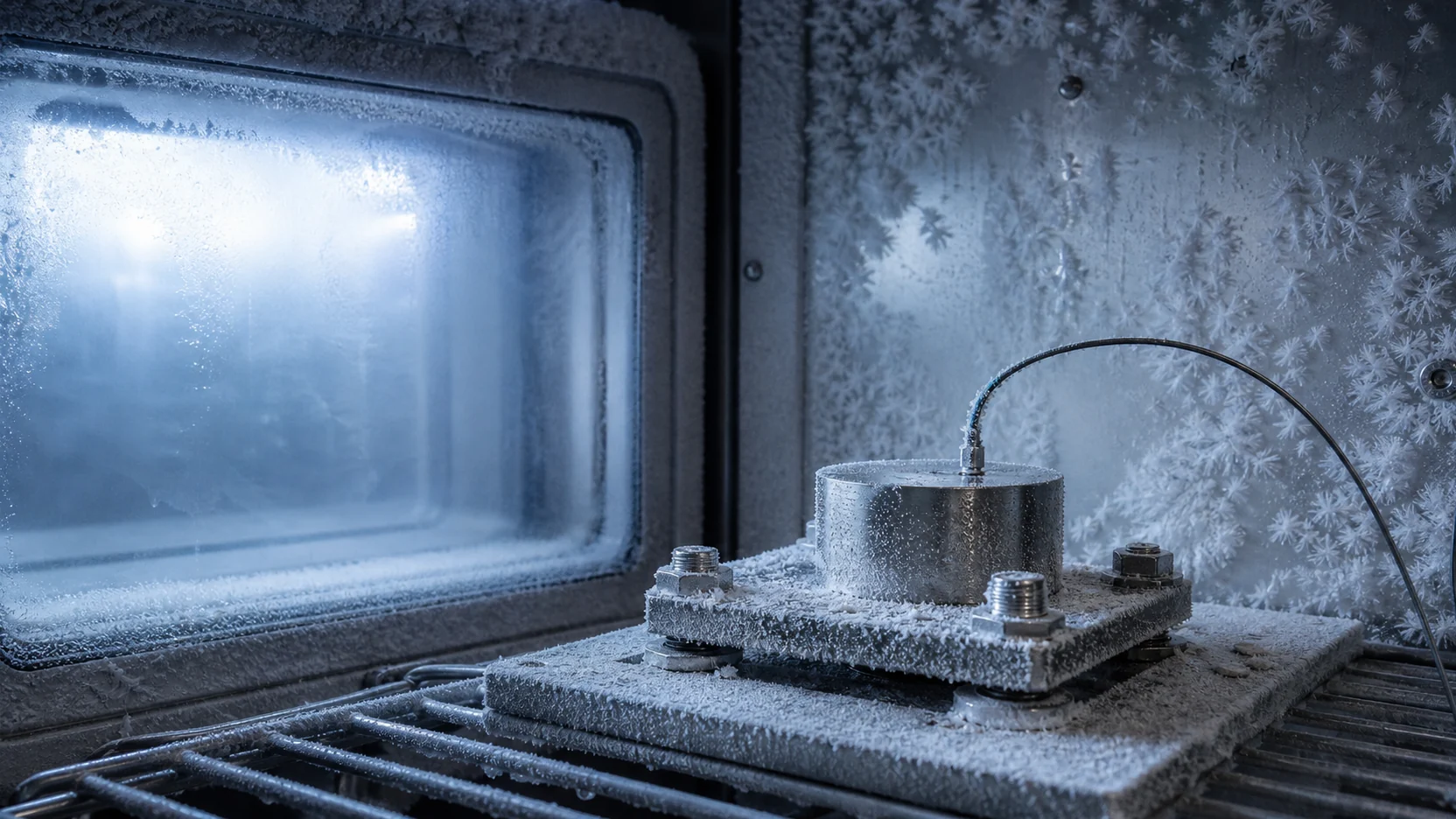
Temperature and humidity are the conditions most often needed and most often delayed, because external laboratory slots are scarce. We run those in our own hot/cold and humidity chambers, which means a design iteration is tested in days rather than weeks. Conditions the chambers cannot reproduce — full vibration spectra, salt fog, altitude — go to an external laboratory.
Before any of it, the condition is analysed: modal extraction and random vibration analysis predict the response, so the test confirms a prediction rather than discovering a failure. A worked example from that chain: a mast platform under wind load returned 37 MPa maximum stress and 0.18 mm deformation, giving a minimum safety factor of 7.
Six questions to ask any supplier
- Which methods, and for each: which procedure and which severity?
- Which revision of the standard, and does the evidence match it?
- Was the equipment operating during the test, or only exposed?
- What configuration and which drawing revision was tested, and how does it differ from what you are quoting me?
- Was it one article through the whole campaign, and what failed?
- Which tests were done in-house and which by an accredited laboratory?
A supplier who can answer these in a paragraph has done the work. One who repeats “MIL-STD-810G qualified” has told you nothing you can compare.