HIL test bench commissioned for motion control software
The new hardware-in-the-loop bench makes control software for gimbal and positioning systems verifiable without a physical prototype.
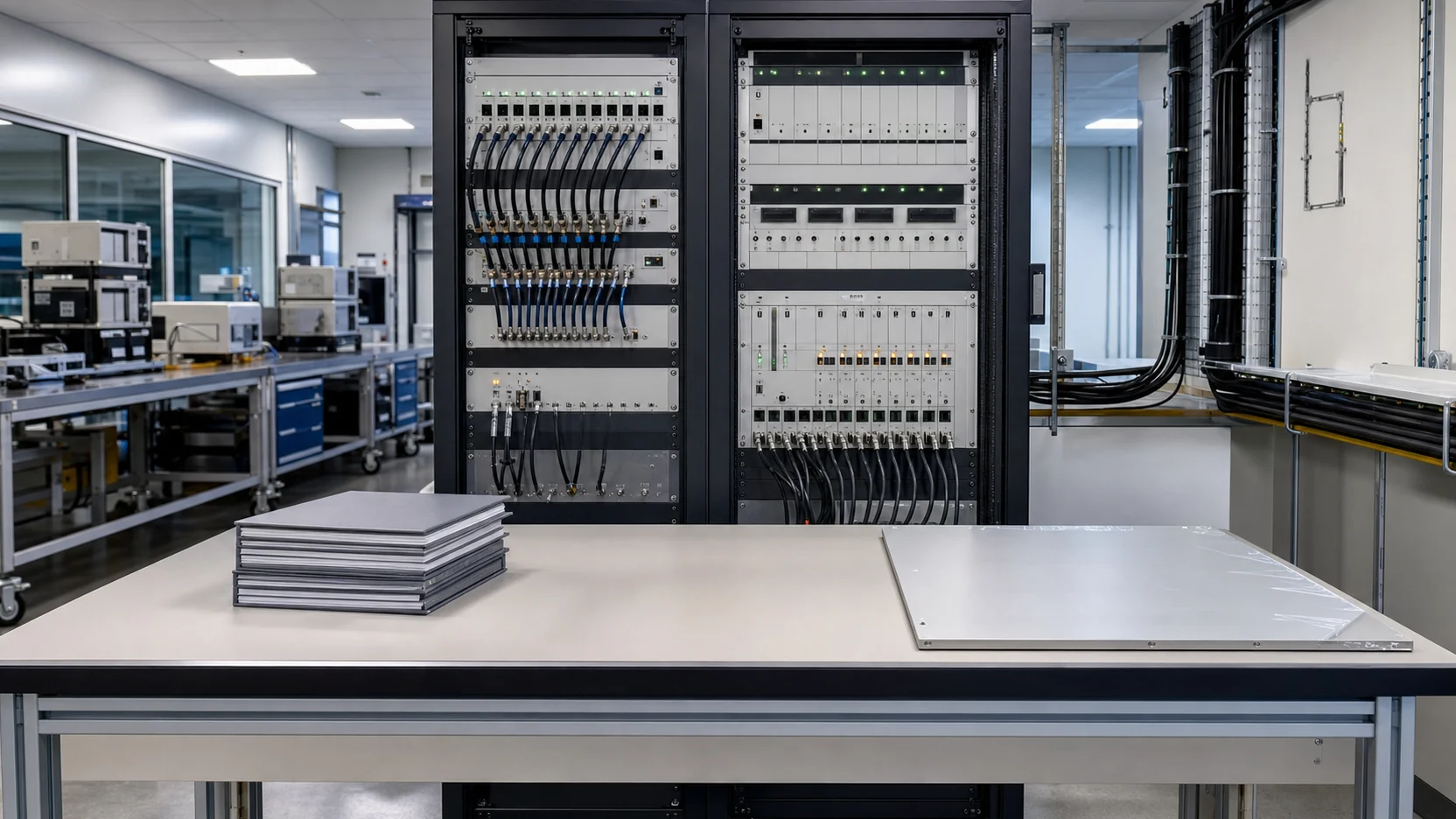
Inventra Mühendislik has commissioned a hardware-in-the-loop (HIL) test bench at its OSTİM Integration & Test Centre. The bench was built to verify the embedded software of motor driver boards used in gimbals, pan-tilt positioners and mast systems before the mechanical hardware is available.
At its core is a real-time plant model solving BLDC/PMSM behaviour including phase-current dynamics, friction, backlash and load inertia. The electrical domain is stepped at microsecond scale so it can follow the driver’s PWM switching frequency; the mechanical domain runs at a lower loop rate.
That difference in step size is the whole reason the bench exists rather than a simulation running on a desk. Phase current under PWM is not a value but a waveform, and where in the switching period the driver samples it determines whether the current loop is closing on the average or on the ripple. A model that cannot resolve the switching period cannot show that error, and a simulation with an idealised measurement will never show it at all. It appears only against a real converter, a real interrupt controller and a plant that answers back in time.
Fault scenarios — phase loss, encoder faults, supply dropout — can be injected in a controlled, repeatable way, which is the second thing the bench is for. On real hardware these cases are either dangerous or impossible to repeat identically, so they tend to be tested once and remembered rather than tested continuously.
The infrastructure is set up to run alongside automated regression suites: every software change reaches the team as a coverage and deviation report, so a fault-handling regression is found on the day it is introduced instead of during integration.
The practical benefit is straightforward — failure cases can be exercised repeatably without putting real hardware at risk, and integration begins with far more mature software.