A 2.45-Metre Tripod Needs 16 Metres of Ground
A guyed mast claims far more ground than its tripod covers, and the stake circle — not the base — decides where masts can stand. Work the anchored footprint from the published heights, then plan a multi-mast site around the circles rather than the poles.
The base diameter is not the footprint
A datasheet gives the base diameter, and a site plan drawn from that figure will be wrong. The tripod is the part you carry; the part you have to clear, own and keep people off is the circle of ground the guy stakes occupy.
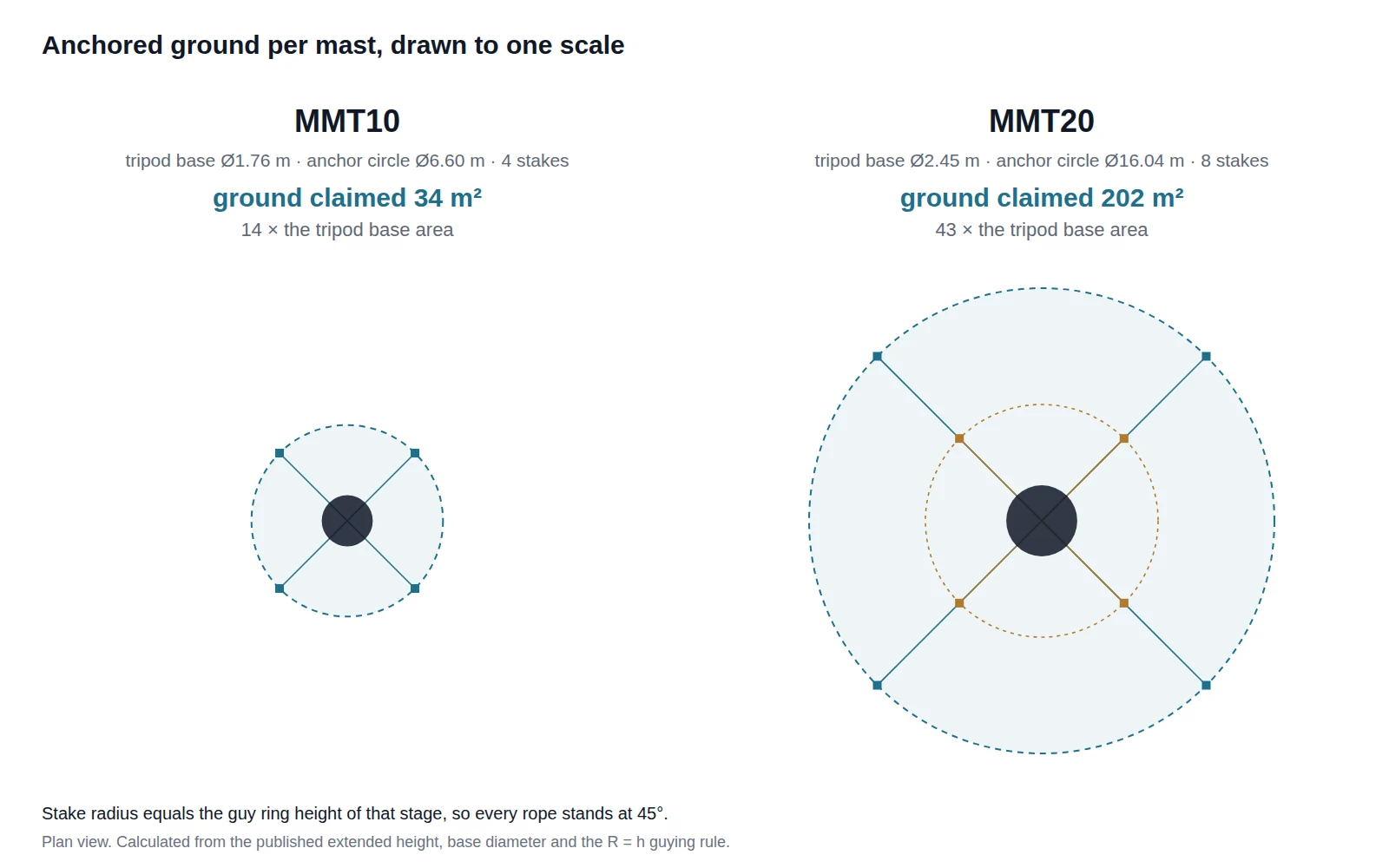
The geometry is fixed by one rule. In the Inventra S³ Guy Wire Installation Guide, the stake radius for a guy stage equals the height of that stage’s guy ring, which puts every rope at 45°. The rule holds for each stage independently, all stages share the same four azimuth lines, and each stage gets its own stake.
That makes the outer radius equal to the mast’s extended height. For the two portable masts, taking the published extended height and base diameter:
| MMT10 | MMT20 | |
|---|---|---|
| Extended height | 3.30 m | 8.02 m |
| Base diameter | 1.76 m | 2.45 m |
| Outer stake radius | 3.30 m | 8.02 m |
| Anchor circle | 6.60 m | 16.04 m |
| Stakes | 4 | 8 |
The stake counts come from the guide’s minimum stage table: up to 5 m needs one stage, 5–10 m needs two, and stage spacing may not exceed 5 m. The MMT20 at 8.02 m therefore carries two stages, at 8.02 m and 4.01 m, each with four stakes. Its lowest stage sits well above the 1.40 m tripod top the guide sets as the floor.
Turning radii into areas: π × 8.02² is 202 m² for the MMT20, against π × 1.225² or 4.7 m² for its base. The installation claims about forty-three times the ground the tripod covers. For the MMT10 the ratio is about fourteen.
What the second mast costs
A sensor site is rarely one mast. Antennas that must not shadow each other, a sensor head that needs its own sight line, and a radar that was there first all end up on the same patch of ground.
Two MMT20 circles stop overlapping at 16.04 m centre to centre. Below that, one mast’s stakes and ropes cross ground the other has claimed — which is not automatically a fault, but it is a decision, and it has to be made before the stakes go in rather than discovered when the second crew arrives. The guide states that site constraints permit some deviation from the ideal radius and defines the limit; what it does not permit is shortening a radius silently to make two masts fit.
Three consequences follow for the layout, and none of them are visible on a datasheet:
- Cable routes and walkways cross guy lines. Four ropes per stage at 45° leave four clear sectors. Anything on foot — a generator run, a coax trunk, a path to the shelter — either uses those sectors or passes under a rope at a height that falls as the rope nears its stake.
- Stakes need their own ground, not just the mast’s. The outer stakes of an 8 m mast land 8 m out in whatever surface is there. Ground that carries the tripod says nothing about ground that will hold a stake 8 m away.
- Adjacent stake circles compete for the same anchor points. Two masts 12 m apart have overlapping circles with stakes landing in the shared strip, where one crew’s hammer finds the other crew’s rope.
When the ground will not take a stake
The radius is the geometric half of the problem. The other half is whether the point at that radius will hold.
The guide classes pull-out capacity by soil and embedment, identified by hand rather than by instrument: for a 25 mm round stake at 610 mm embedment, very stiff ground gives 6.0 kN and very soft ground 0.24 kN — a factor of twenty-five across the range a single site can contain. Saturated ground halves the figures. Inventra S³ applies a safety factor of 3.0 to them, above the 1.5–2.0 the source recommends.
Drive angle matters less than the ground does. Between 5° and 15° from vertical there is no capacity loss; at 30° the stake keeps 77 % of it.
Where a stake cannot be driven, the guide names the substitution rather than leaving it to the crew: an anchor bolt or a ballast block on asphalt and concrete, an expanding wedge anchor in rock, drilling instead of driving in frozen ground, and a duckbill or helical screw anchor in soft saturated soil. On a mixed site, a single mast can need two of these on different lines. The heavy-duty stake kit and the chemical anchor are order options on both masts.
A site survey that records only where the masts go has recorded the easy half.
Record the radii, not just the height
The guide ships an installation form, and one copy stays with the system. It has a row for every stage: measured guy ring height and measured stake radius. The reason to fill it in is that the next crew inherits a site, not a drawing — and the fastest way to check an installation is to compare what is in the ground with what the form says should be.
Three entries carry most of the value:
- Stage heights and stake radii, as measured. Pacing sets them at about 0.75 m per step; the form records where they actually landed.
- Soil class per line, by hand. Lines on one mast can sit in different ground, and the weakest line sets the installation.
- What was substituted, and why. A rock anchor on one line and a driven stake on the other three is a normal result; an unrecorded one is a repair nobody can plan.
Tension does not belong in the list as a force. The guide sets it by mark: take up the slack, mark where each rope enters the adjuster, then tension until the mark passes the adjuster by 10 cm — about 1 % of the guyed length. What matters is that all four are equal, because four equal ropes on four equal radii stand the mast up by themselves. If it leans, the fault is in the stake position, not the tension.
Related reading: Mast Sizing: Payload, Height and Wind · A Heavy Tripod Can Still Move