SEB20 multi-channel thermal imaging system completes environmental qualification
The SEB20 thermal imaging system has completed an environmental qualification campaign spanning MIL-STD-810G vibration and shock profiles through to IP68 immersion testing.
- Standard
- MIL-STD-810G
- Test Scope
- Vibration, shock, humidity, IP68 sealing
- Temperature
- -32 °C / +60 °C
- Location
- Integration and Test Centre, Ostim OSB
- Resolution
- 1.920 × 1.080 px
- Detector
- 1.280 × 1.024 px
- Ranging Scope
- 5-32.000 m
- Weight
- 18,4 kg
Inventra’s SEB20 multi-channel (EO/MWIR/LRF/LD) thermal imaging system, developed for weapon stations, sighting systems and commander periscopes, has completed its environmental qualification campaign.
During the campaign the system was subjected to MIL-STD-810G random vibration and mechanical shock profiles, temperature-humidity cycling across its operating range and IP68 sealing verification. Testing was carried out at Inventra’s Integration and Test Centre in Ostim OSB, Ankara.
Test conditions
Under the MIL-STD-810G conditions published in the SEB20 specification, vibration testing follows Method 514.6, Procedure I, Category 4 (secured cargo), Figure 514.6C-3. Mechanical shock is specified under Method 516.6, Procedure I, at 40 g and 11 ms, with three shocks per direction along each of the three axes.
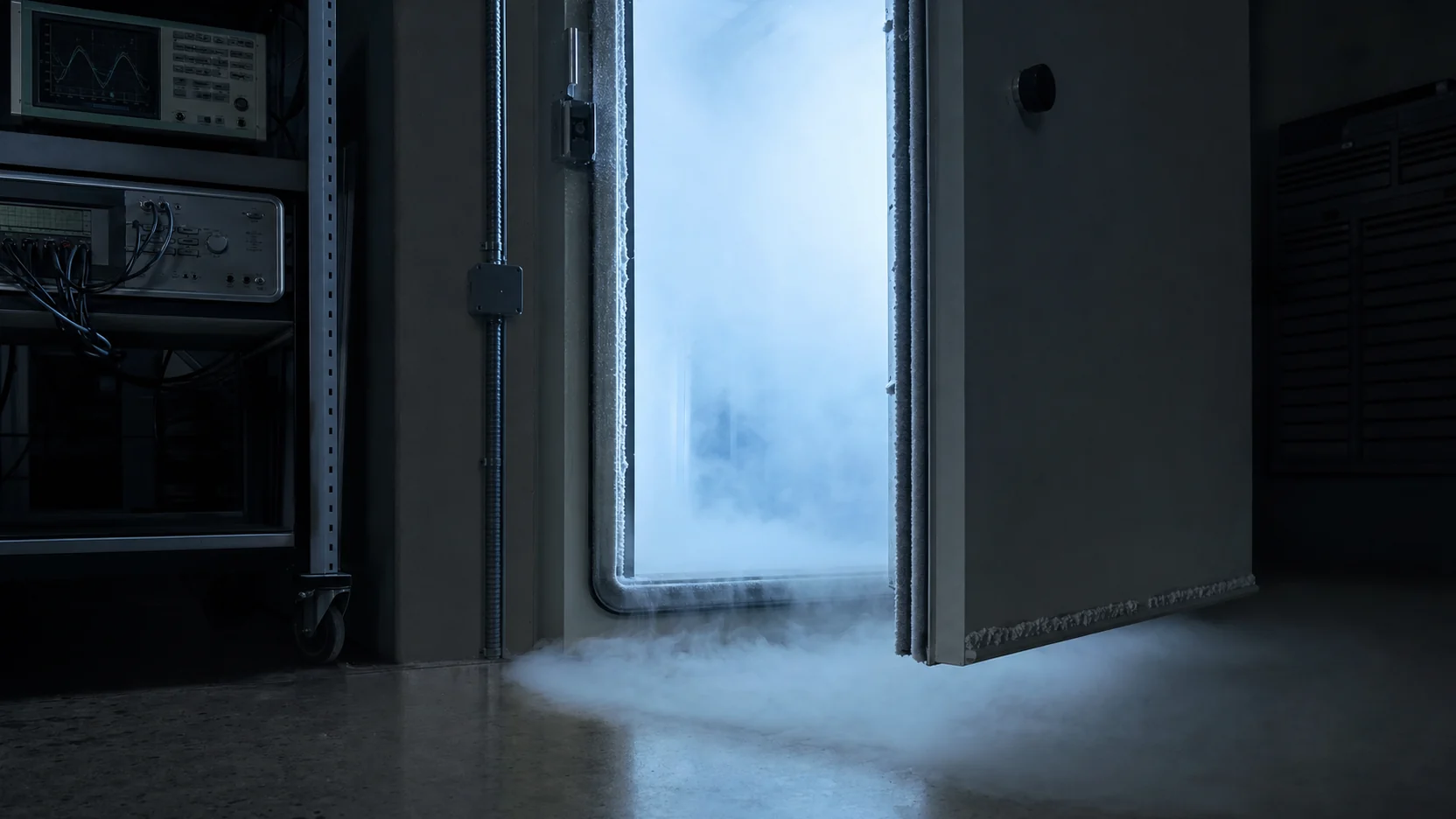
The operational high and low temperature tests are specified under Methods 501.5 and 502.5, Procedure II, at +60 °C and -32 °C respectively. The humidity test, under Method 507.5, Procedure II, consists of ten 24-hour cycles at 90% relative humidity, non-condensing, at +60 °C.
System features
SEB20 combines a 1920×1080 daylight channel, a 1280×1024 mid-wave infrared (MWIR) thermal channel, a 32 km laser rangefinder (LRF) and an optional laser designator (LD) in a single 18.4 kg enclosure.
In the standard configuration the daylight channel offers 50× optical zoom. The thermal channel has a 12 µm pixel pitch, 20 mK thermal sensitivity (NETD) and 20× optical zoom. The eye-safe LRF operates at 1.5 µm, while the LD delivers 50 mJ at 1064 nm and supports STANAG 3733 Band I and Band II pulse codes.
Tracker stabilisation uses fibre gyro and encoder based dual-loop control, and the stabilised optical path is designed to preserve line-of-sight (LOS) stability under vibration. The full specification is on the SEB20 Multi Channel (EO-MWIR-LRF-LD) Thermal Imager page.
Test report
The procedure, severity and configuration applied in each test of the campaign are recorded in the test report. Two qualification campaigns can only be compared on those three terms, so the report is the document to request when comparing SEB20 with another system.
The MIL-STD-810G Environmental Qualification Report and the MIL-STD-461G EMI/EMC Test Report are issued on request during quotation, after export control review. What an environmental test report can and cannot support is examined in the white paper It Passed After the Heat. Did It Work During the Heat?.
About Inventra
Inventra Mühendislik A.Ş., founded in 2015, designs, manufactures, integrates and qualifies reconnaissance and surveillance systems at its R&D Centre and its Integration and Test Centre in Ankara. Its product line covers multi-channel stabilised thermal imaging gimbals, single and dual axis positioners, masts, tripods and portable climatic rack cabins.
Media contact: infoinventras3.com