Persistent 24/7 watch at a fixed site: the range gained at 14 metres
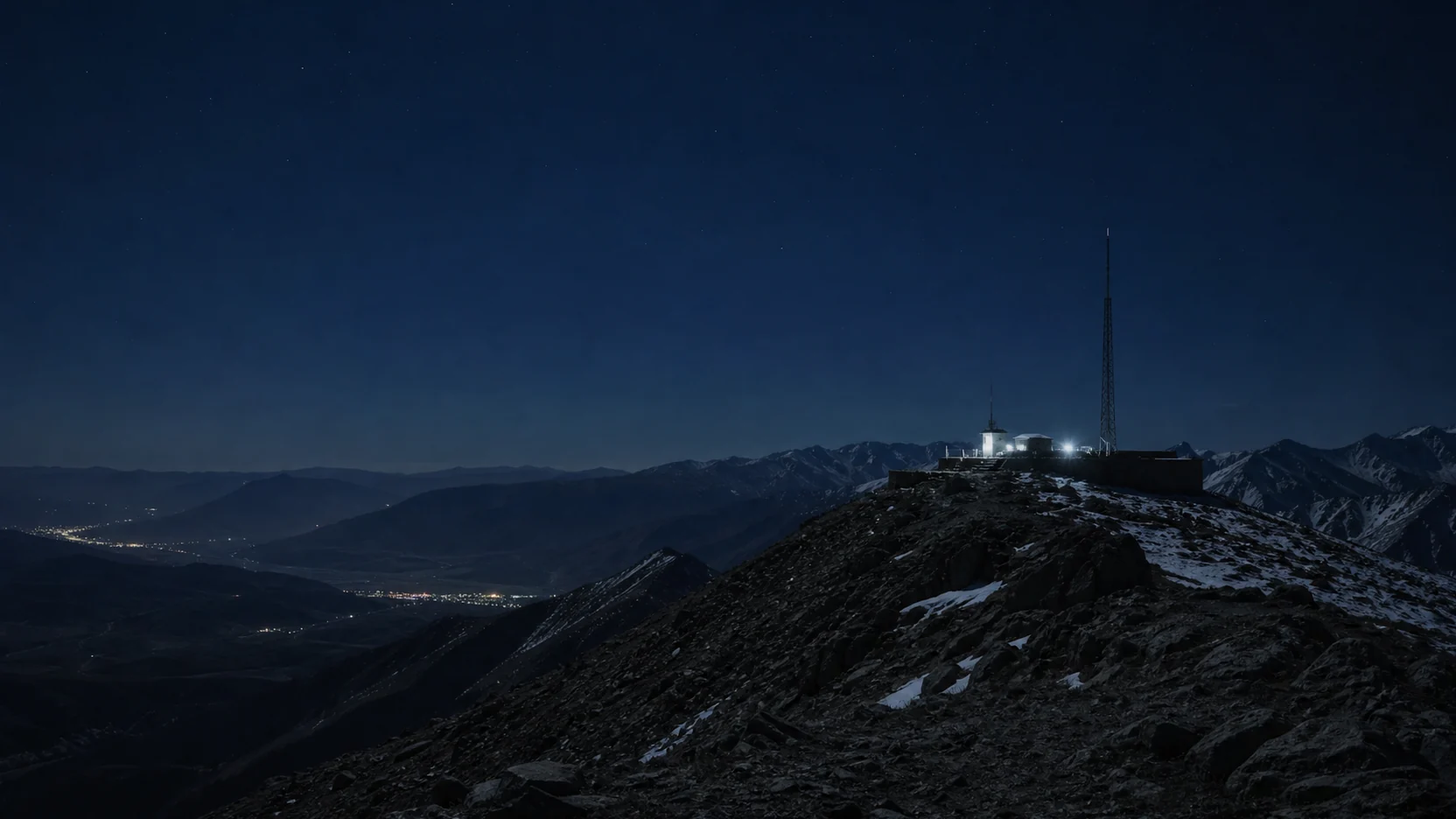
Persistent 24/7 surveillance with a SEG14 sensor on a 14 m electromechanical mast: radar slew-to-cue and 32 km laser ranging.
- Resolution
- 1.920 × 1.080 px
- Detector
- 1.280 × 1.024 px
- Ranging Scope
- 5-32.000 m
- Weight
- 8,0 kg
SEG14 · 14 m electromechanical mast · radar slew-to-cue
The requirement
The site already had radar. Radar reports that something is there and how far away it is; it does not report what it is. The requirement was therefore not “see further” but “turn a radar track into an identified target, and do it before the answer stops being useful” — continuously, unattended, through every hour and every season.
Two constraints did most of the shaping. The mast never comes down, so anything that needs periodic attention is fourteen metres above the people who would give it. And the performance figure that mattered was not range but elapsed time: from the moment radar declares a track to the moment an operator has a stable, identifiable picture of it.
The configuration
A SEG14 sensor on a 14 m electromechanical mast, slewed to cue by the site’s radar, with laser ranging out to 32 km.
14 m because height is bought for two separate reasons and this site needed both: the geometric horizon extends with height, and the dead zones that nearby ground clutter carves out of a low sensor’s coverage close up. Neither is obtained by a better sensor at a lower height.
Electromechanical because the mast stays extended for months. A drive that holds its position through a power interruption, with self-locking and independent braking, is answering a question about failure rather than about raise speed. There is also nothing to leak: a column held at height by pressure creeps as its internal pressure follows the daily temperature, and creep at 14 m is a pointing error that grows through the afternoon.
Laser ranging because the radar’s range belongs to the radar’s detection. To hand a coordinate to anything else, the system needs its own measured range to the object the camera is actually looking at, which is not necessarily the object the radar found.
What the engineering had to solve
Slew-to-cue fights the mast it is standing on. This was the finding that shaped the system. A 14 m mast is a long cantilever with a low first bending mode. Every fast slew of the positioner puts a torque impulse into the top of that cantilever, and the mast answers by swinging. The image arrives at the cued bearing and is then unusable until it stops moving. Time to a usable image is slew time plus settle time, and settle time grows with how hard you slew. There is an optimum slew rate, and it is not the maximum slew rate. A system specified on maximum slew rate is specified on the wrong number.
Two sensors have to agree about where things are. A radar cue is only a cue if the camera’s angular frame matches the radar’s. At long range the narrow thermal field of view is a small window, and a disagreement of a fraction of a degree between the two frames puts the target outside it entirely. The operator then sees empty ground and concludes the radar was wrong. Harmonising the frames is unglamorous work, and keeping them harmonised is harder still, because the structure carrying one of them bends with wind and, on a still clear day, with the sun on one side of it.
Everything that needs a hand is at the top. The maintenance question was settled before the imaging question. On a mast that does not come down, a consumable is not an operating cost, it is an outage plus a lift.
A range is measured along a line, and the line moves. A range measurement taken along a line of sight that is displaced by mast deflection is an accurate range to the wrong place.
The result
The site converts a radar track into an identified, ranged target without anyone going up the mast, and it does so at whatever hour the track appears. The number worth quoting from the programme is not the 32 km and not the 14 m; it is the elapsed time from cue to stable picture, and that number was improved more by slewing less aggressively than by slewing faster.