Height buys range; deflection gives it back
A 15 m mast widens the horizon — but a few centimetres of deflection at the top become tens of metres of miss distance at 5 km. That conversion is what the design is really about.
Why go up
Raising a sensor from 3 m to 15 m buys two concrete things: the geometric horizon extends (from roughly 6.2 km to 13.8 km over flat ground), and the dead zones created by nearby obstacles — brush, walls, vehicles — close up. For fixed-site surveillance that is coverage gained without installing another sensor.
The price is mechanical: every metre of height increases both the wind moment arm and structural compliance.
Wind load in order-of-magnitude terms
Dynamic pressure scales with the square of velocity:
q = ½ · ρ · v² · (ρ ≈ 1.225 kg/m³)
At 25 m/s (about 90 km/h), q ≈ 383 Pa. Take a payload with 0.5 m² of frontal area and a drag coefficient C_d ≈ 1.2, and the force on the payload alone is ≈ 230 N. Over a 15 m arm that is an overturning moment of 3.4 kNm at the base — before adding the drag of the mast body itself.
The real message is not the magnitude but the square-law scaling: double the wind speed and the load quadruples. This is why “what wind will it operate in” and “what wind will it survive undamaged” are two separate specifications and must never be merged.
From deflection to pointing error
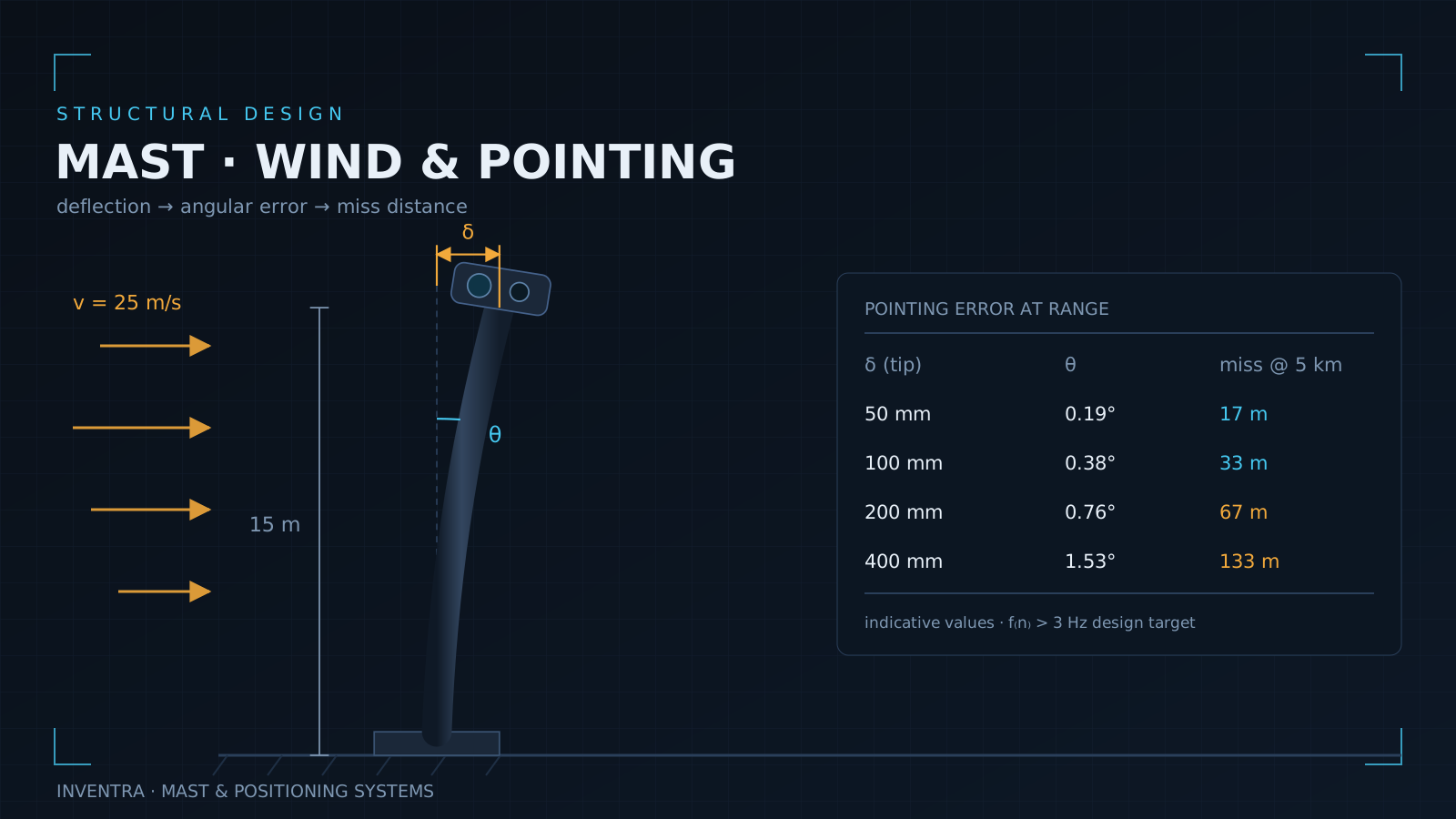
Horizontal tip deflection δ converts directly into angular error: θ ≈ arctan(δ / h). For a 15 m mast:
| δ (tip deflection) | θ | Miss at 5 km |
|---|---|---|
| 50 mm | 0.19° | ~17 m |
| 100 mm | 0.38° | ~33 m |
| 200 mm | 0.76° | ~67 m |
| 400 mm | 1.53° | ~133 m |
This table turns “how rigid is the mast” into “how accurate is the system”. If your pan-tilt positioner offers 0.04° pointing accuracy, a 0.38° structural deflection renders that figure meaningless — the positioner’s budget disappears next to the mast’s.
The critical distinction: static deflection can be compensated, dynamic deflection cannot. The mean bend produced by a steady wind can be taken out by calibration or a pre-engagement correction. Gust-driven oscillation is a real-time disturbance and can only be suppressed structurally or by gimbal stabilisation.
Natural frequency: the specification everyone forgets
A mast is a long, relatively compliant cantilever; its first bending mode typically sits between 1 and 4 Hz. Two risks follow:
- Wind turbulence carries much of its energy in the 0.1–2 Hz band. If the natural frequency falls inside that band, even a modest wind produces sustained oscillation.
- Vortex shedding excites in a narrow band: f ≈ St · v / D. With a Strouhal number St ≈ 0.2 and a body diameter D = 0.15 m, a light 2 m/s breeze produces excitation at ≈ 2.7 Hz — an unfortunate coincidence with the natural frequency of a typical mast, and one that appears on a calm day rather than in a storm.
Hence our practical design target: keep the first mode in the extended position above 3 Hz, and ensure it does not coincide with the shedding frequency across the design wind range.
Design trade-offs
| Option | Gain | Cost |
|---|---|---|
| Free-standing (unguyed) mast | Fast deployment, small footprint | Larger section, heavier base |
| Guyed mast | Far higher stiffness, lighter body | Setup time, land area, manpower |
| Pneumatic mast | Light, fast, quiet | Seal maintenance, locking required |
| Electromechanical mast | Intermediate stops, repeatability, remote control | Heavier, power draw |
| Mechanical locking stages | Markedly reduces deflection and creep | Extra mechanism, extra mass |
The point most often missed on pneumatic masts: pressure is there to lift. In the extended position the load should be carried by a mechanical lock, not by pressure. Otherwise internal pressure varying with temperature turns into slow creep at the top and a pointing error that grows through the day.
Conclusion
The right question when selecting a mast system is not “how many metres and how many kilograms” but: at the design wind speed, how many milliradians of error remain at the top, and how much of that is static versus oscillatory? The answer sets your sensor’s effective range.